Free Get a real winning motivation letter, CV & the ECA playbook
IELTS Writing Practice Test 1

IELTS Writing Task 1 and 2 Sample Answers for Band 5-9

Read the real exam questions below, then compare five real responses per task. Whether you need IELTS Writing Task 1 and 2 Sample Answers for Band 5 or Band 6 to improve your foundational skills, or you are targeting a high score with IELTS Writing Task 1 and 2 Sample Answers for Band 7 and above, each essay includes full examiner-style feedback to help you succeed.

1

The Question — Writing Task 1

You should spend about 20 minutes on this task.

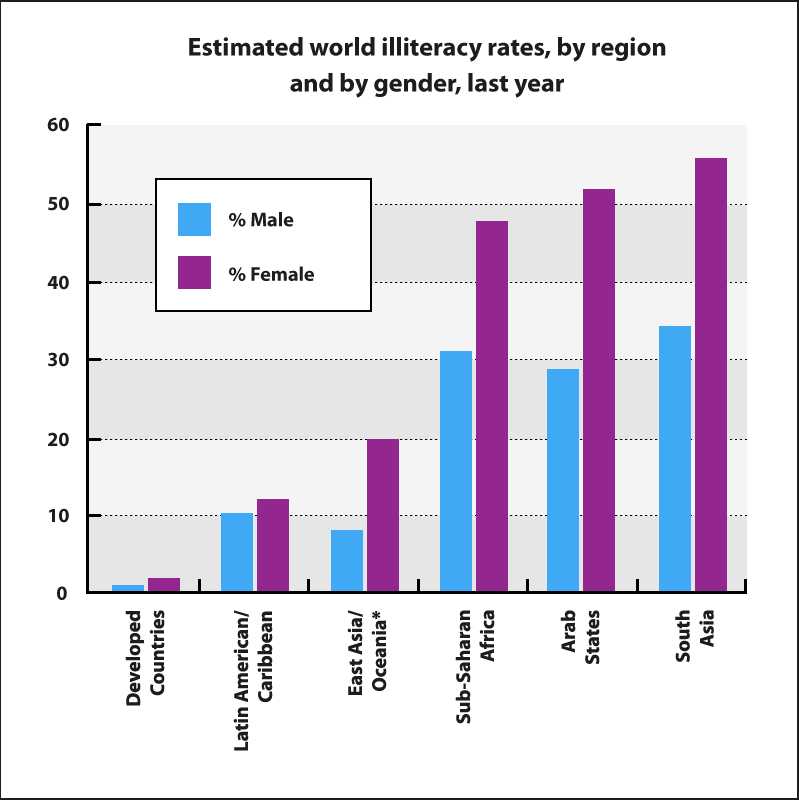
The bar chart below shows estimated world illiteracy rates by region and by gender for the last year. Summarise the information by selecting and reporting the main features, and make comparisons where relevant.

You should write at least 150 words.

Bar chart showing estimated world illiteracy rates by region and gender, IELTS Writing Task 1 and 2 Sample Answers for Band 5-9
2

The Question — Writing Task 2

You should spend about 40 minutes on this task.

There is a lot of pressure on young people today to succeed academically. As a result, some people believe that non-academic subjects, such as physical education and cookery, should be removed from the school syllabus so that children can concentrate on academic work.

To what extent do you agree or disagree?

Give reasons for your answer and include any relevant examples from your own knowledge and experience.

You should write at least 250 words.

3

IELTS Writing Task 1 Sample Answers (Band 5 to 9)

Pick a band below to read the actual response alongside examiner-style feedback on Task Achievement, Coherence & Cohesion, Lexical Resource, and Grammar.

IELTS Writing Task 1 Sample Answers for Band 5

150 words

The bar chart illustrates relative amount of illiteracy around the world, including variations between women and men in the previous year.

Overall, there were the nearly double amount of illitarate women than men with this disability in all categories of coutries. This rate account a significantly proportion of whole population, around 60 percentages of all women in Sub-Saharan Africa, Arab States and South Asia.

The statistic indicate that the one of the lowest rate of illiteracy had Latin American/Caribbean, which is the sixth of the rate of women in South Asia and the triple amount of men in the same country. The percentage of individuums of both gender were roughly the same as opposed to remainder with one exception of Developed Countries. Their rate was close to zero. Also, the good rate was demonstrated by men from East Asia/Oceania, the smallest proprtion compared with number of women from the same geografic area.

Examiner Feedback

You partially met the task. To improve, ensure you provide a clear overview of the data, highlighting key trends and patterns. Avoid focusing too narrowly on specific data points without summarizing the overall picture.

Your paragraphing shows a basic structure, but ideas are not always linked clearly. Use more accurate linking words and avoid overloading single sentences with multiple ideas.

Vocabulary is limited and contains spelling errors (e.g. 'illitarate', 'coutries', 'individuums', 'geografic'). Work on accurate spelling and a wider range of topic-specific vocabulary.

There are frequent grammatical errors, including subject-verb agreement ('rate account', 'statistic indicate') and awkward phrasing. Focus on accuracy with basic and complex sentence structures.

IELTS Writing Task 1 Sample Answers for Band 6

151 words

The bar chart demonstrates the percentage of males and females who are not able to read in different countries over one year.

According to this chart, the number of illiterate women is higher all around the world. However, it is the lowest rate in developed countries, at almost zero per cent. Africa, Arab States and South Asia fluctuate at 50 per cent. Therefore, South Asia distinguished the highest rate.

Looking at the details, illiteracy in South Asia is double the number of the same phenomenon in East Asia. Latin America has nearly the same percentage of male and female population with no reading skills.

To sum up, the bar chart illustrates the issue of illiteracy over a particular period in different parts of the world among both sexes. The majority of such people are in South Asia and the minority is in developed countries, with women dominating in this tendency.

Examiner Feedback

Your response identifies some key features but lacks a comprehensive overview. Focus on providing a broader analysis that includes all regions and ensures data accuracy.

Paragraphing is logical and ideas progress clearly, though some linking between comparisons could be stronger. Try connecting related data points more explicitly.

You use adequate vocabulary for the task, but repetition of simple terms like 'rate' and 'number' limits your score. Introduce more varied descriptive language.

A mix of simple and complex sentences is used with reasonable accuracy, though some errors remain (e.g. 'fluctuate at 50 per cent'). Review word choice within sentence structures.

IELTS Writing Task 1 Sample Answers for Band 7

151 words

The bar chart illustrates the estimated illiteracy rates by gender across different world regions last year. Developed countries are grouped together, while other regions represent developing or less developed areas.

Overall, South Asia recorded the highest illiteracy rate, followed closely by the Arab States and Sub-Saharan Africa. In contrast, Latin America / the Caribbean and East Asia / Oceania reported significantly lower levels of illiteracy, with developed countries showing near-total literacy.

In South Asia and the Arab States, female illiteracy exceeds 50%, while in Sub-Saharan Africa, it is slightly below that figure. Meanwhile, male illiteracy rates in these regions are considerably lower, hovering around 30%. In East Asia and Latin America, the figures are much smaller, with female illiteracy slightly above 10% and male illiteracy below this threshold. Additionally, developed countries exhibit negligible illiteracy rates for both genders.

This data underscores the persistent gender gap in literacy, particularly in regions with lower economic development.

Examiner Feedback

You provide a clear and well-developed overview of the data, effectively highlighting key trends. However, a slightly deeper comparison between regions would make your analysis even stronger.

Information is organised logically with a clear overview and supporting paragraphs. A wider range of cohesive devices would help ideas flow even more naturally.

You use a good range of vocabulary, including some less common items, with generally accurate word choice. Aim for greater precision with a few less-common collocations.

A good mix of simple and complex sentence structures is used with good control. Minor errors are present but do not impede communication.

IELTS Writing Task 1 Sample Answers for Band 8

157 words

The bar chart illustrates the estimated percentages of illiterate males and females across six regions worldwide for the previous year. Overall, the data shows that women experienced higher illiteracy rates than men in every region, with the largest differences found in developing areas.

South Asia reported the highest rates, with around 35% of men and 55% of women unable to read or write. Similarly, the Arab States and Sub-Saharan Africa exhibited significant gender gaps, where roughly 50% of women were illiterate compared to about 30% of men. In contrast, East Asia and Oceania had lower rates, with approximately 7% of men and 20% of women lacking literacy skills.

Latin America and the Caribbean presented more moderate figures, with both genders below 15%. Developed countries had the lowest illiteracy rates overall, with minimal gender differences, both remaining under 5%.

In summary, South Asia, the Arab States, and Sub-Saharan Africa showed the highest illiteracy levels, with women consistently more affected than men.

Examiner Feedback

You addressed all main features and made relevant comparisons. To improve, provide slightly more precise numerical references without overwhelming the description.

Your writing is clear and well-structured. For improvement, add a few additional linking words to ensure smoother transitions between points.

Your vocabulary is mostly appropriate and varied. Enhance the writing by reducing minor repetitions and using more sophisticated formal expressions.

While your sentence structures are accurate, aim to avoid repetition by not always including phrases such as “with minimal…”, “with women consistently…”, “with approximately…”.

IELTS Writing Task 1 Sample Answers for Band 9

198 words

The bar chart illustrates the estimated illiteracy rates by gender across various world regions for the previous year. Overall, women had higher illiteracy rates than men in every region, with the gender disparity being particularly pronounced in developing areas.

South Asia and Sub-Saharan Africa exhibited the highest illiteracy rates, with over half of the female population unable to read or write, compared to approximately one-third of men. The Arab States followed closely, displaying a similar trend of gender disparity, though at slightly lower levels. In contrast, East Asia and Oceania had moderate illiteracy rates, with women's rates at 20%, while male illiteracy remained below this threshold.

Latin America and the Caribbean recorded relatively low illiteracy rates (approximately 10%), with a minor gender gap, making them comparable to East Asia. Developed countries had the lowest levels of illiteracy (around 2%), with near-universal literacy for both men and women. These figures highlight the stark contrast between highly developed nations and those with limited access to education.

In summary, while illiteracy rates were consistently higher among women worldwide, the extent of the gender gap varied significantly by region. The most severe disparities were found in developing nations, whereas more developed regions showed minimal differences.

Examiner Feedback

You have covered all key features and made clear comparisons. Your summary is well-developed with precise data references. No improvements needed.

Your writing is logically structured and flows smoothly. The use of linking words is effective and ensures readability. Perfectly cohesive.

You have used a wide range of academic vocabulary appropriately. Your phrasing is accurate and natural, enhancing clarity. No suggestions for improvement.

Your grammar is flawless, with diverse sentence structures. You demonstrate excellent control of tenses, punctuation and complex forms. No issues identified.

4

IELTS Writing Task 2 Sample Answers (Band 5 to 9)

Explore these IELTS Writing Task 2 Sample Answers from Band 5 up to Band 9. Compare how the argument, structure, and language proficiency develop as the band scores increase.

IELTS Writing Task 2 Sample Answers for Band 5

164 words

In todays society, there is big pressure on young people to succeed in academic. Because of this, some peoples think we should remove non-academic subjects like sport and cookery from school. I not agree with this, since it cause more problem for students.

Firstly, if students only learn things like maths and science, they not have time for exercise, so they become unfit and unhealthy. Physical Education help them stay in good shape and learn teamwork. Also cooking class is very useful skill, because it allow children to cook healthy meals and maybe find interest in future career as a chef.

Secondly, focusing only on academic can make kids bored and stressful. Non-academic subject give them break from study and let them enjoy school. If we take these things away, they will lose motivation to attend classes.

In conclusion, I strongly disagree to remove non-academic subjects from the syllabus. Students need variety in their education, so they can develop different skills and keep themselves healthy and motivated.

Examiner Feedback

You present a clear stance, which is positive. To improve and meet the task, provide more specific reasons or evidence to strengthen your argument. This would also increase your word count.

Ideas are connected using basic linking words (Firstly, Secondly, In conclusion), but paragraphing could be more consistent. Group related ideas together more clearly to help the reader follow your argument.

Vocabulary is limited and repetitive, with frequent errors (e.g. 'todays', 'peoples', 'it cause'). Build a wider range of topic vocabulary and check spelling carefully.

There are frequent grammatical errors, particularly with subject-verb agreement ('I not agree', 'they not have time'). Focus on basic verb forms and negation structures.

IELTS Writing Task 2 Sample Answers for Band 6

255 words

Some people think that extra subjects like sports and cooking are not important in school, and children should only study academic subjects to get better grades and succeed in the future. I do not agree with this because non-academic subjects help children stay healthy and learn useful life skills that cannot be learnt any other way.

First, learning physical education helps children improve their body and mind. Sports like football and basketball make children stronger and more active. Also, doing any type of exercise helps the brain work better, so students can focus more on their studies. For example, some research shows that students who do regular exercise get better marks in school than those who don't. But if children do not have sports in school, they might not get enough physical activity.

Second, cooking is a very important skill for the future. If children learn cooking, at least 10 recipes, they can take care of themselves when they grow up. Many people today use food delivery apps like Uber Eats, which is unhealthy. If children know how to cook, they will eat better food and save money. Also, cooking can be a fun activity that helps them relax. It can also contribute to family bonding if parents and children cook together.

In conclusion, I believe that subjects like sports and cooking should not be removed from school because they help children stay healthy and independent. Schools should keep these subjects so students can have a better future, not only in terms of theoretical knowledge but also physical health.

Examiner Feedback

You present a clear opinion and relevant arguments. Your points are strong, but adding more depth and explanation would make them even more compelling.

Paragraphs are organised around clear main points with reasonable linking. A wider range of cohesive devices between sentences would help ideas flow more smoothly.

You use adequate vocabulary with some good topic-specific words ('recipes', 'delivery apps'), though word choice is occasionally imprecise. Aim for more varied and precise expressions.

A mix of simple and complex sentences is used with reasonable control, though errors remain (e.g. verb tense consistency). Continue practising complex sentence structures.

IELTS Writing Task 2 Sample Answers for Band 7

224 words

In today's globalized world, academic education has become a major topic of discussion. Some people believe that children should focus only on academic subjects and that non-academic subjects like physical education and cookery should be removed from the school curriculum. However, I strongly disagree with this view, as these subjects provide essential benefits for students.

One important reason why physical education should be included in schools is that it helps students maintain both physical and mental health. Regular physical activity improves concentration and reduces stress, allowing students to perform better in their academic subjects. For example, research has shown that students who engage in regular exercise tend to achieve higher grades compared to those who do not. Furthermore, if physical education is removed, students may not get enough exercise, leading to health issues such as obesity and fatigue.

Similarly, learning cookery is not just about making food; it is an essential life skill that helps individuals become more independent. Knowing how to cook allows people to prepare healthy meals instead of relying on unhealthy fast food. For instance, studies indicate that individuals who cook at home tend to have better nutrition and lower rates of obesity. Moreover, cooking skills can open career opportunities, as many high-paying jobs exist in the food industry, such as chefs and restaurant managers.

In conclusion, while academic subjects are important, physical education and cookery play a crucial role in students' overall development. Removing them from the curriculum would have negative consequences on students' health, independence, and future opportunities. Therefore, schools should continue offering these subjects to ensure a well-rounded education.

Examiner Feedback

You present a clear position and support it with relevant arguments. Your points are well-developed, though expanding certain ideas further could make your argument even stronger.

Your essay follows a clear, logical structure with an introduction, two body paragraphs and a conclusion. Using a wider range of cohesive devices within paragraphs would strengthen the flow further.

You use a good range of vocabulary, including some less common items, with generally accurate word choice. Aim for greater precision with a few less-common collocations.

A good mix of simple and complex sentence structures is used with good control. Minor errors are present but do not impede communication.

IELTS Writing Task 2 Sample Answers for Band 8

232 words

The pressure on young people to succeed academically is increasing. Consequently, some argue that non-academic subjects like physical education and cookery should be excluded from school curricula to allow students to focus solely on core subjects. I disagree with this perspective because such subjects contribute to both physical and mental well-being, as well as essential life skills.

To begin with, academic subjects are undoubtedly vital for future career opportunities. Mastering subjects such as mathematics, science, and literature is key to accessing higher education and well-paid professions. However, prioritizing only academic learning could negatively impact students' holistic development. Excessive academic pressure has been linked to increased stress, anxiety, and even burnout among teenagers, ultimately hindering their ability to perform well. If students are constantly overwhelmed with studies, they may lose motivation and struggle to retain information effectively.

On the other hand, non-academic subjects offer numerous advantages. Physical education not only improves students' physical fitness but also enhances concentration, which can positively influence their academic performance. Additionally, learning practical skills such as cooking fosters independence and prepares students for adulthood. Moreover, subjects like music, drama, or art provide creative outlets that boost self-confidence and emotional well-being, helping students cope with academic stress. Without such opportunities, students may struggle to develop social skills and creativity, which are essential for personal growth.

In conclusion, while academic subjects are crucial, removing non-academic subjects from school programs would be harmful. A well-rounded curriculum that balances both academic and non-academic subjects is essential for students' overall growth and long-term success.

Examiner Feedback

Your essay effectively addresses the prompt with clear reasoning and examples. To strengthen your response, consider acknowledging opposing views more explicitly.

Ideas progress logically with clear paragraphing and effective use of linking devices. For a higher score, ensure every paragraph maintains a single central idea throughout.

Your vocabulary is wide-ranging and mostly precise, with some less common lexical items used naturally. Continue refining collocations for even greater flexibility.

You use a wide range of complex structures with good accuracy. Minor slips do not affect meaning; review punctuation within longer sentences.

IELTS Writing Task 2 Sample Answers for Band 9

285 words

In today's competitive world, academic success is often prioritized, leading some to argue that non-academic subjects, such as physical education and cookery, should be removed from school curricula to allow students to focus entirely on core academic disciplines. While this perspective highlights the importance of academic excellence, I firmly believe that eliminating non-academic subjects would be detrimental to students' overall development. A balanced education system that incorporates both academic and practical subjects is essential for producing well-rounded individuals.

Supporters of this view argue that subjects like mathematics and science improve academic performance and job prospects. With a demanding job market, they believe prioritizing core subjects enhances university admission rates and career opportunities. Additionally, they claim that extracurricular activities can be pursued outside school, allowing students to focus exclusively on academics. However, this assumes all students have access to such activities, which is not always the case. Many families lack the financial resources to enroll their children in private sports clubs or art classes, widening the gap between privileged and underprivileged students.

Non-academic subjects, however, are essential for students' well-being and success. Physical education improves fitness, cognitive function, and concentration, benefiting academic performance. Cookery fosters self-sufficiency and promotes healthy eating habits, equipping students with practical skills they will need in adulthood. Moreover, creative subjects like music and drama develop emotional intelligence, teamwork, and problem-solving skills, which are highly valued by employers. Without these, students risk becoming overly focused on academic achievements at the expense of their personal growth.

In conclusion, while academic subjects are fundamental, non-academic disciplines are equally crucial. A well-rounded curriculum equips students with both knowledge and essential life skills, ensuring they thrive in their personal and professional lives. Therefore, non-academic subjects should remain a vital part of education.

Examiner Feedback

You have covered all key features and made clear comparisons. Your summary is well-developed with precise data references. No improvements needed.

Your writing is logically structured and flows smoothly. The use of linking words is effective and ensures readability. Perfectly cohesive.

You have used a wide range of academic vocabulary appropriately. Your phrasing is accurate and natural, enhancing clarity. No suggestions for improvement.

Your grammar is flawless, with diverse sentence structures. You demonstrate excellent control of tenses, punctuation and complex forms. No issues identified.

Practice More with Our Free IELTS Tests

Continue your preparation with our complete collection of mock tests. Practice under timed conditions and boost your score across the reading, writing, and listening modules:

Ready to test your own writing?

Take the free mock, submit your own Task 1 and Task 2 answers, and get an instant AI-scored band with the same criteria used above.

Take Writing Practice Test 1

FAQ

What is a Band 7 sample answer for IELTS Writing?
A Band 7 answer provides a clear, well-developed position or overview with logical organisation. By reviewing IELTS Writing Task 1 and 2 Sample Answers for Band 7, you will notice a good range of vocabulary and sentence structures with only minor errors that don't affect meaning.
How is IELTS Writing scored?
Both Task 1 and Task 2 are scored on four equally-weighted criteria: Task Achievement/Response, Coherence and Cohesion, Lexical Resource, and Grammatical Range and Accuracy. Comparing IELTS Writing Task 1 and 2 Sample Answers for Band 5 to Band 9 helps you see how these criteria are applied.
What is the difference between a Band 5 and a Band 6 answer?
When looking at IELTS Writing Task 1 and 2 Sample Answers for Band 5 vs Band 6, a Band 5 essay usually has repetitive vocabulary and frequent grammar errors, while a Band 6 answer addresses the prompt better and uses a wider mix of simple and complex sentences despite some mistakes.
How many words should IELTS Writing Task 1 and Task 2 be?
Task 1 should be at least 150 words and Task 2 at least 250 words. Writing under the word count loses marks for Task Achievement/Response, even if the content is otherwise strong.

Never miss a deadline.

Join 4,000+ students. Get weekly scholarship deadlines and a free checklist of 70+ international scholarships instantly.